Trolling motor shopping trips up more anglers than almost any other marine electronics purchase, because the spec sheet throws three separate decisions at you at once — thrust, shaft length, and control type — and getting any one of them wrong means a motor that’s underpowered, mismatched to your boat, or annoying to actually use. Here’s how to work through all three.
Thrust: Matching Power to Boat Weight
Thrust is measured in pounds and is roughly the trolling motor’s version of horsepower. The rule of thumb is about 2 lbs of thrust for every 100 lbs of fully-loaded boat weight (boat, motor, fuel, gear, and passengers) in calm conditions — add extra headroom if you regularly fish wind or current. A loaded 18-foot bass boat around 3,000–3,500 lbs typically wants 80–115 lbs of thrust, which is why bow-mount motors like the Minn Kota Ultrex Quest 90/115 are sized the way they are. A kayak or small jon boat, by contrast, is well served by 30–55 lbs of thrust from something like a compact kayak trolling motor.
Shaft Length: Getting the Prop Depth Right
Shaft length determines how deep the prop sits below the waterline, and it’s boat-specific, not angler-specific. Measure from the mounting point (bow deck or transom) down to the waterline, then add roughly 18–20 inches so the prop stays submerged even when the bow pitches in chop. Too short and the prop cavitates and loses bite in waves; too long and it drags unnecessarily or the motor sits at an awkward angle. Bow-mount motors on bass and multi-species boats commonly run 45 to 60-inch shafts; transom mounts on jon boats and small craft are typically much shorter.
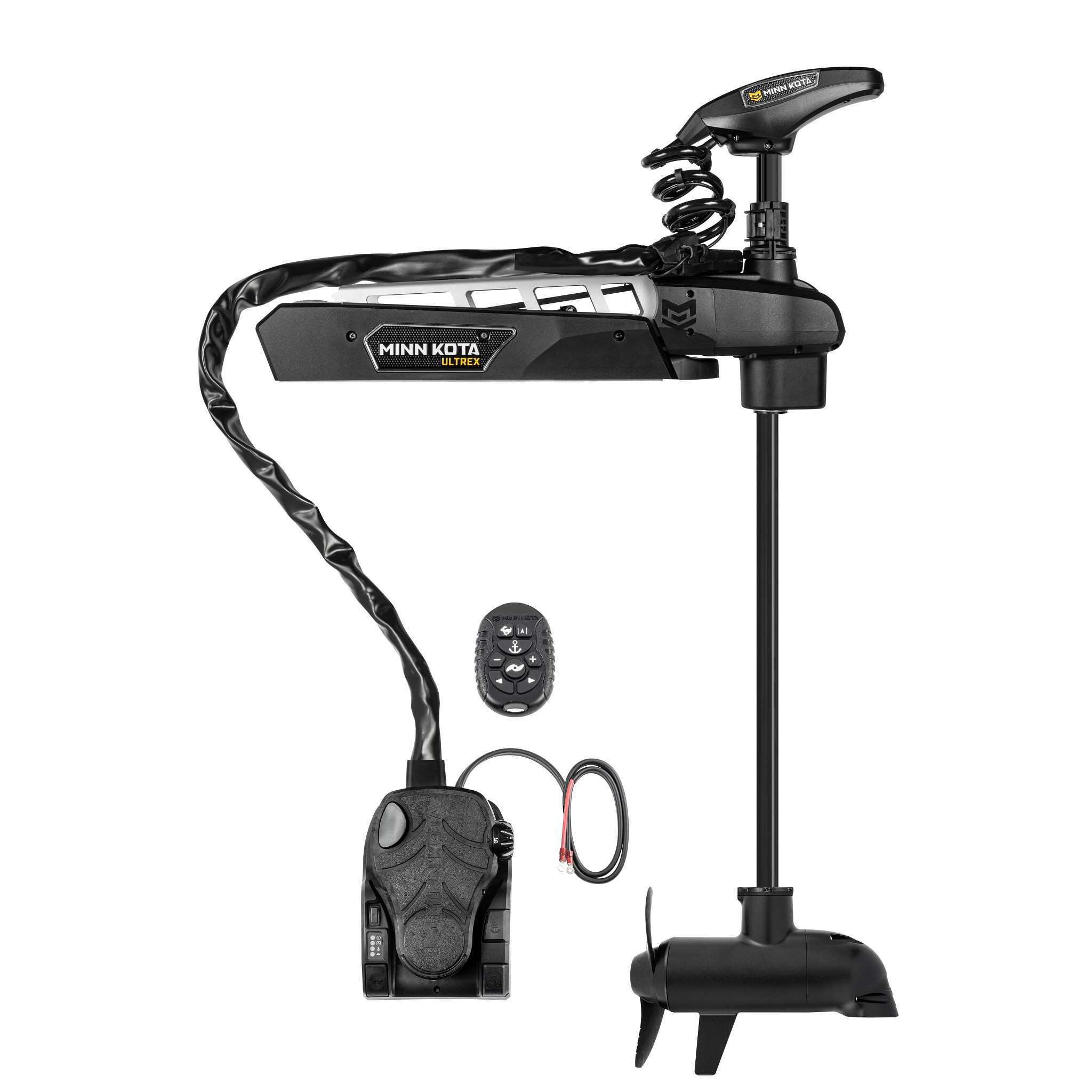
Control Type: Foot Pedal, Hand-Tiller, or Remote/GPS
Transom-mount motors are typically hand-tiller controlled directly at the motor head — simple, affordable, and fine for smaller boats where you’re steering near the stern anyway. Bow-mount motors offer more choice: a mechanical foot pedal steers by cable and keeps your hands free to fish, while electric steer models add wireless remotes and, on higher-end units, GPS features like Spot-Lock (holding a precise position automatically) and route recording. If you fish structure or wind-heavy water, GPS anchor-lock features on motors like the Minn Kota Terrova 80 i-Pilot GPS pay for themselves quickly by letting you fish instead of constantly repositioning.
Built-In Sonar: A Growing Trend
Several current trolling motors integrate sonar directly into the lower unit, effectively giving you a second transducer at the bow pointed wherever the motor is aimed — useful alongside a transom or thru-hull unit for a fuller picture. Units like the Minn Kota Ultrex 80 Quest with MEGA Down Imaging Plus pair Humminbird’s imaging sonar right into the motor head, and the Ultrex Quest 90/115 above adds Dual Spectrum CHIRP for the same reason. If you’re also considering forward-facing live sonar for the bow, our live sonar vs. traditional sonar guide explains how the two technologies complement rather than replace each other.
Frequently Asked Questions
Can I put too much thrust on a small boat?
Not really from a safety standpoint, but you’re paying for capability you won’t use and adding unnecessary weight and battery draw — size to your actual boat weight rather than buying the biggest motor available.
Do I need GPS Spot-Lock, or is a plain foot pedal enough?
If you fish current, wind, or precise structure (docks, brush piles, ledges) regularly, Spot-Lock earns its keep fast. If you mostly drift-fish open, calm water, a mechanical pedal is simpler, lighter, and less expensive to maintain.
How much battery capacity do I need to run a trolling motor all day?
As a rough guide, a 12V motor at 55 lbs of thrust draws roughly 20–30 amps at full power; a full day of mixed-speed use typically calls for at minimum a dedicated deep-cycle marine battery sized to your motor’s voltage and expected run time — 24V and 36V systems (like most 80lb+ bow-mounts) need matched battery banks, not a single 12V battery.
Freshwater vs. saltwater trolling motors — is there a real difference?
Yes. Saltwater-rated motors use additional corrosion protection on fasteners, wiring, and the lower unit. Running a freshwater-only motor in salt will shorten its life significantly, so check the rating before buying if you fish brackish or coastal water even occasionally.
Ready to compare real models at every price point? See our best trolling motors for bass fishing roundup, or browse the full trolling motor collection.
Leave a Reply