A 36-volt trolling motor will not deliver full thrust, and will not give you full runtime, if the battery bank, breaker and cable are undersized, and the symptoms are always the same: surging under load, a head unit that reboots, and batteries that seem tired after half a day. This guide shows how to build a 36 V bank from three 12 V batteries, size the breaker and cable, avoid the series-wiring mistakes that ruin batteries, and decide between AGM and lithium.
How a 36 V trolling motor bank is wired
A 36 V system is three identical 12 V batteries connected in series: positive of battery 1 to negative of battery 2, positive of battery 2 to negative of battery 3. The trolling motor connects to the free negative terminal on battery 1 and the free positive terminal on battery 3. A "dual" 36 V arrangement means two separate 36 V banks (six batteries) with a selector switch so you can run one bank while the other recovers or serves as a spare. The wiring rules below apply to each bank.
Rules for series banks
- Use three identical batteries: same brand, model, capacity and age.
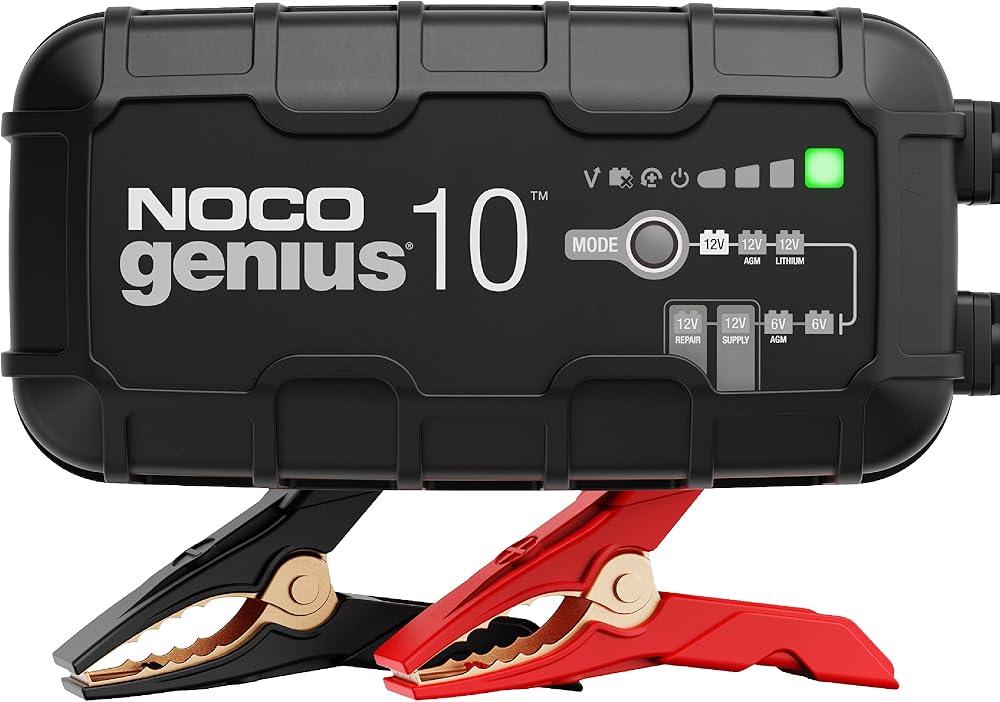
- Charge each battery individually with a 3-bank on-board charger sized for the chemistry.
- Keep jumper cables short, the same gauge as the main leads, and fully crimped.
- Label every battery and cable, and fuse the positive close to the first battery.
| Part | Specification | Notes |
|---|---|---|
| Batteries | 3 × identical 12 V deep-cycle (AGM or LiFePO4) | Same model, same age |
| Breaker | Manual-reset marine breaker rated to the motor manual (commonly 50 A at 36 V) | Within 7 inches (18 cm) of the battery positive |
| Wire | 6 AWG or heavier for long runs, tinned copper | Marine-rated, correct lug sizes |
| Charger | 3-bank on-board, matched to chemistry | One bank per battery |
| Bank selector (dual bank) | Marine battery switch rated for the load | Never break the circuit while the motor is running |
Breaker size and wire gauge
Choose the breaker from the motor’s rated maximum current draw in the manual. Many 24 V and 36 V motors specify a 50 A manual-reset marine breaker, but 12 V high-thrust motors can require 60 A or more. The breaker protects the cable, so it must not exceed the cable’s ampacity.
Voltage drop is where most installations lose performance. At 50 A, a long run of undersized wire wastes a significant portion of a 36 V bank. Use Vdrop = 2 × length (m) × current (A) × 0.0172 ÷ area (mm²).
| Run (one way) | 8 AWG (8.4 mm²) | 6 AWG (13.3 mm²) | 4 AWG (21.2 mm²) |
|---|---|---|---|
| 4.6 m (15 ft) | 0.95 V (2.6%) | 0.60 V (1.7%) | 0.37 V (1.0%) |
| 6.1 m (20 ft) | 1.26 V (3.5%) | 0.79 V (2.2%) | 0.50 V (1.4%) |
| 9.1 m (30 ft) | 1.87 V (5.2%) | 1.18 V (3.3%) | 0.74 V (2.1%) |
Percentages are of a 36 V bank at 50 A. Aim to keep voltage drop under 3% on trolling motor leads. For a 30-foot run on a large boat, 4 AWG is a sensible choice, and shortening the run by moving the bank forward is better still.
Installer Tip: Crimp quality matters as much as wire size. A cold or loose crimp adds resistance and heat at 50 A. Use a hydraulic or ratchet crimper with correct lugs and add adhesive-lined heat-shrink. After the first hard run, check lugs by hand for warmth: a hot lug means high resistance.
AGM vs lithium for a 36 V bank
| Factor | AGM deep-cycle | LiFePO4 lithium |
|---|---|---|
| Usable capacity | About 50% for long life | 80 to 100% |
| Weight per 100 Ah | About 60 to 65 lb | About 25 to 31 lb |
| Voltage under load | Sags as discharged | Stays nearly flat |
| Cycle life (typical) | 300 to 500 cycles | 3,000 to 5,000 cycles or more |
| Charging | Standard marine charger | Charger set to a LiFePO4 profile; no charging below 32 °F (0 °C) unless heated |
Lithium keeps thrust consistent through the day and cuts boat weight, but it needs a lithium-specific charger and must be rated for series connection (many manufacturers allow up to four batteries in series for 48 V). Check the battery maker’s guidance before wiring in series.
Charging a 36 V bank
An on-board 3-bank charger charges each battery independently, which keeps a series bank balanced. Select a charger with enough amps per bank for your capacity (a rule of thumb is 10 to 20% of battery Ah as charge amps) and a lithium profile if you use lithium. Mount the charger where it stays dry and ventilated, and fuse every charger lead near the battery.
Troubleshooting a weak or surging trolling motor
- Measure open-circuit voltage on each battery; they should be within 0.2 V of each other when fully charged.
- Measure total bank voltage at the motor with the motor running at full throttle; a large drop from the resting voltage points to wiring resistance.
- Check each lug and the breaker for heat and corrosion.
- Test the bank with a load tester or by timing a measured discharge.
- Replace the weakest battery only if you can match the rest; otherwise replace the set.
Fish finder power: do not share the trolling motor bank
Run fish finders and live sonar from a dedicated 12 V battery or a DC-DC converter, not from one battery of the 36 V bank. Taking 12 V from a single battery in a series bank unbalances it and shortens its life.
Get the right gear
Browse our trolling motors collection and electronics and power for chargers and monitoring. For wire gauge and fusing detail, read our voltage drop guide, and ask our team for a wiring plan matched to your boat.
Runtime planning with real numbers
Runtime depends on how hard you run the motor, not on its rated thrust. A 36 V motor drawing 20 A on a typical day on the water pulls 720 W, but the same motor on full power can draw more than 50 A. Use an average rather than a maximum when you plan a bank.
| Bank | Usable capacity | Average draw | Approximate runtime |
|---|---|---|---|
| 3 x 12 V 100 Ah AGM in series | About 50 Ah at 50% discharge | 20 A | About 2.5 hours |
| 3 x 12 V 100 Ah AGM in series | About 50 Ah at 50% discharge | 30 A | About 1.7 hours |
| 36 V 100 Ah LiFePO4 | About 80 Ah at 80% discharge | 20 A | About 4 hours |
| 36 V 100 Ah LiFePO4 | About 80 Ah at 80% discharge | 30 A | About 2.7 hours |
These are planning figures; wind, current, weeds and boat weight change them. Add a safety margin so you can run back to the ramp against the wind.
Charging and storage
- Use a charger matched to the chemistry: AGM and LiFePO4 need different charge profiles.
- Charge after every trip: leaving lead-acid batteries discharged shortens their life quickly.
- Store at partial charge for long periods if using lithium, and follow the manufacturer’s guidance on storage temperature.
- Check connections each season: loose or corroded terminals cause heat and voltage drop at high current.
Common installation mistakes
- Undersized cable: at 50 A, cable that is too small gets hot and wastes power. Use the cable gauge the motor manufacturer specifies and keep the run short.
- No circuit breaker or fuse near the battery: a 50 to 60 A marine breaker close to the battery protects the cable.
- Mismatched batteries: mixing old and new batteries in a series bank reduces capacity and shortens life.
- Wrong charger: a 12 V charger cannot charge a 36 V series bank correctly unless it is a multi-bank unit.
Troubleshooting a 36 V trolling motor system
| Symptom | Likely cause | Fix |
|---|---|---|
| Motor loses power at high speed | Voltage drop from undersized cable or a weak battery | Measure voltage at the motor under load; upgrade cable; test each battery |
| Breaker trips repeatedly | Overload, short or loose connection | Check for chafed cable and hot terminals; confirm breaker rating |
| Short runtime | Aging batteries or an unbalanced bank | Test each battery separately; replace the weakest and match the set |
| Charger will not start | Wrong chemistry setting or a battery below the charger minimum | Check settings and individual battery voltage |
| Motor stutters on the water | Corroded terminal or loose plug | Clean and tighten all connections, including the motor plug |
Run through this table before assuming the motor is faulty. In most service calls we see, the fault is a connection, not the motor itself. Check plugs and terminals for warmth after a run: heat means resistance.
Frequently asked questions
What size breaker does a 36V trolling motor need?
Follow the motor manual. Many 24 V and 36 V motors specify a 50 A manual-reset marine breaker, mounted within about 7 inches of the battery positive and rated no higher than the cable ampacity.
What wire gauge should I use for a 36V trolling motor?
At 50 A, 6 AWG is common for runs up to about 20 feet and 4 AWG is better for 30 feet. Keep voltage drop under 3%.
Can I use lithium batteries for a 36V trolling motor bank?
Yes, if the batteries are rated for series connection and you use a lithium-compatible charger. Many LiFePO4 makers allow up to four batteries in series.
Should I run my fish finder from the trolling motor batteries?
Use a separate 12 V battery or a DC-DC converter. Drawing from one battery in a series bank unbalances the bank and shortens battery life.